Telstra, NBN Co finally come to agreement

Telstra has finally signed an $11 billion definitive agreement with the National Broadband Network Company and the Federal Government, which will see it decommission its copper network, lease its ducts and pits to NBN Co and move customers onto the NBN, just over a year after the heads of agreement was first announced.
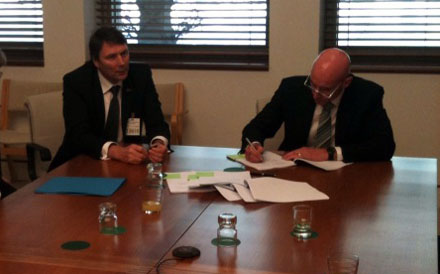
NBN Co's Mike Quigley and Telstra's David Thodey signing the heads of agreement
(Credit: NBN Co)
Over the next 10 years, Telstra has agreed under the deal to progressively move customers off its copper network and hybrid fibre-coaxial network, but the telco will keep the HFC in place for pay TV. For Telstra's customers, NBN Co will pay $4 billion over the next 10 years. For $5 billion, Telstra will also lease dark fibre, exchange space, lead-in-conduits and ducts to NBN Co over the next 35 to 40 years, with the option to extend the deal twice by 10 years.
The government will also give Telstra $700 million to fund its universal service obligations, $300 million for greenfields fibre deployment, as well as a further $1 billion for other government commitments over 10 years.
Telstra said that it expected to spend around $2 billion to support the agreement, with money being spent on infrastructure and the customer migration. Some of these costs would be recouped by savings in legacy network product and IT investment costs.
Telstra chair Catherine Livingstone said that the agreement comes after two years of negotiations between Telstra and NBN Co.
"The government's commitment to the NBN and other related policy changes meant that the Telstra board had to decide whether the company should participate in the NBN roll-out or pursue other options," she said. "The decision to participate was made on the basis that the proposed transaction is expected to provide us with the ability to recover more value for the business than the available alternatives, given the loss of value after the NBN policy announcements."
Telstra has also secured product and pricing commitments from NBN Co for basic voice and data services. According to Telstra, NBN Co will reveal this in a full product terms document and this portion of the deal will still need consultation with industry.
"These agreements represent an important milestone in addressing much of the uncertainty for Telstra associated with the NBN and government regulation, and allow us to focus intently on our customer service and simplification strategy," Telstra CEO David Thodey said.
"The government will achieve its desired industry structure and the arrangements for the [universal service obligation] and associated social obligations will be reformed to ensure that funding for these public interest services is secured. Within this new environment, we look forward to continuing to focus on customer service, content and innovation," he added.
There are a number of conditions in the deal to protect both NBN Co and Telstra in the event that the roll-out runs into trouble or is amended under a change of government. Telstra will, for instance, be able to reconnect customers to its copper network in the event that the NBN service is unavailable, is insolvent or permanently ceases ongoing operation.
For the next 20 years from the commencement date under the agreement, Telstra must not promote its wireless services as a substitute for fibre-based services or build a passive optical network.
If the roll-out of the network is slow, NBN Co may be liable to pay Telstra up to $500 million. NBN Co said that in the event that the project is cancelled entirely, Telstra will be protected through the cash flows from its existing copper network and HFC network customers in the areas where the NBN has not been rolled out.
NBN Co will also be required to pay for all dark fibre links, and the exchange space it uses over a 35- to 40-year period, even if the government changes policy, such as in the event that the Coalition wins government.
Until 1 July 2032, Telstra will remain responsible for providing standard telephone services across Australia, including the supply, installation and maintenance of payphones.
The portion of the long-awaited deal involving Telstra's structural separation and the migration of customers onto the NBN will still require the approval of the Australian Competition and Consumer Commission. Telstra shareholders will also have to approve the deal at the company's annual general meeting in Sydney on 18 October 2011.
Stay tuned to ZDNet Australia for further news on this breaking story.