Customs is wrapping up an AU$5.5 million trial of an unmanned spy plane next week, used to keep watch for criminal activities such as illegal fishing.
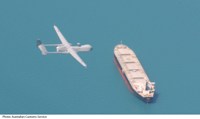
UAV over a merchant ship
(Credit: Customs)
The unmanned aerial vehicle (UAV) is being used in a pilot to watch out for quarantine and border threats. It is based at Weipa, north Queensland, from which it has been flying over the Gulf of Carpentaria, Torres Strait and the Great Barrier Reef.
The 8.5-metre long "Heron" aircraft used in the trial, operated by Israel Aerospace Industries, can fly 1,800km on a single fuel tank as well as take off and land automatically.
Live radar, vessel information, video and photographs are transmitted from the UAV to its Weipa command centre via satellite, then pictures of interest are downloaded to laptops and transmitted to the BPC National Surveillance Centre in Canberra.
According to Nigel Perry, Border Protection Command's acting national director of maritime operations' support division, the plane flies a predetermined flight path, but isn't limited to that particular route: "If you want it to go somewhere else you click and flick and there it goes," he said.
Another advantage of the unmanned plane is that it can fly low and slow, down to 65 knots, allowing its cameras to pick up small detail such as the name of the ship on the hull, and the crew (so as to determine their ethnic heritage), or whether there are livestock on the ship.
The UAV is able to identify vessels over 300 gross tonnes automatically, because the International Maritime Organisation requires them to operate automatic identification systems at all times. These provide information such as the ship's identity, type, position, course and speed.
Perry hopes if the plane is adopted on a long-term basis, it will be controlled remotely from Canberra, so that those controlling the sensors on the craft can speak to operations personnel, helping them see "the big picture".
If the UAV becomes a permanent feature of border control, two new satellites to be launched at the end of this year will provide a dedicated communications link.
The aircraft's last scheduled flight will take place on 2 June, with Customs preparing a report on the trial by the end of the month. The government will then decide on whether to invest in the program on a long-term basis.
For photos of the UAV in action, see the related photo story.


The HERON I is a Medium Altitude Long Endurance (MALE) UAV system for strategic and tactical missions
The HERON I main features and capabilities are:
Multiple operational configurations
Adverse weather capability
Safe, reliable and easy operation
Simultaneously 4 sensors use capability
Satellite communication for extended range (SATCOM)
Two proven simultaneous Automatic Takeoff and Landing (ATOL) systems for maximal safety
Fully redundant, state-of-the-art avionics
Retractable landing gear
Payloads
Electro Optical (TV & IR Combi or Triple Sensor TV/IR/LD)
Synthetic Aperture Radar (SAR)
Maritime Patrol Radar (MPR)
COMINT & ESM capability
Customer furnished sensor suites
Communication relay package
Integrated ATC Radio
Datalinks
Direct Line-of-Sight (LOS) data link
UAV airborne data relay for beyond LOS missions
Ground-based data relay for beyond LOS missions
Satellite communication
Performance
Endurance: 45 hr
Range: 350 km
Range with satellite coverage: Beyond Line of Sight
Altitude: 30,000 ft
Technical Data
Weights
Maximum take-off weight: 1,150 kg
Maximum Payload Weight: 250 Kg
Dimensions
Overall Length: 8.50 m
Wingspan: 16.60 m
Engine 100hp (75kW) Rotax gasoline engine, although IAI also offers a 180hp diesel.
IAI's Tamam Division Announces the Launch of its New Multi-Mission Optronic Stabilized Payload (MOSP3000) Unit
Feb 14, 2008
Israel Aerospace Industries' Tamam Division (IAI/Tamam) has announced the launch of its new Multi-Mission Optronic Stabilized Payload (MOSP3000) unit. MOSP3000 provides advanced image processing and automatic video tracker capabilities, and enhanced surveillance, targeting and geo-location capabilities for a variety of platforms including rotary-wing aircraft, unmanned aerial vehicles (UAVs), aerostats, ground applications and naval vessels. The first customer deliveries are scheduled for 2008 with further orders to additional customers scheduled for 2009.
MOSP3000 is a multi-sensor electro-optic and infrared (EO/IR) payload that is an evolution of the successful MOSP concept. The system is available in 14" inch (36cm) and 15-inch (38cm) diameter configuration, with identical internal design. The 14" unit is designed primarily for UAV and aerostat platforms, while the 15" unit is designed primarily for helicopters, naval vessels and ground applications that require enhanced ruggedized structures.
MOSP3000's open architecture design provides the capability to match the sensor configuration according to customer needs with up to five sensors. The sensor package includes a continuous day color zoom camera, a variety of thermal imaging cameras (up to 640x480 detector format), a laser pointer and an eye-safe laser range finder. A laser designator and laser ranger finder (LRDF) can also be installed.
System highlights:
a. Uses MOSP four gimbals and mechanics concept integrated with Fiber Optics Gyro (FOG) technology and shaft encoders for accurate gimbals angles readout.
b. One line replaceable unit (LRU) with all electronics inside payload
c. "Plug & Play" sensors where each sensor is totally independent and operated digitally
d. Digital control loops for added flexibility
e. Significantly enhanced dynamics (slew rate and acceleration)
f. Enhanced image processing
g. Digital video capability
h. Area auto-tracking in addition to the original correlative and centeroid features
EL/M-2022U- UAV Maritime Patrol Radar System
EL/M-2022 consists of a UAV Radar Payload and a Ground Radar Operator Station that controls the radar operation and processes data sent by the Radar Payload via the UAVs datalink.
The EL/M-2022U Maritime Patrol Radar (MPR) system provides a cost-effective force multiplier solution for the following operational missions:
Support to surface and littoral warfare operations
Maritime surveillance and EEZ patrol
Drug interdiction and prevention o