Nuclear fusion becomes economic reality?

Alex Serpo, ZDNet.com.au
08 February 2008 02:55 PM
Tags: fusion, nuclear, energy, green, power, tokamak, fission

Nuclear Fusion mimics the reactions that occur in the sun to create safe, clean nuclear energy. Sound like hot air? Not according to a leading US venture capitalist who believes it will become economically viable within several years.

"Within five years, large companies will start to think about building fusion reactors," Wal Van Lierop, CEO of Chrysalix Energy Venture Capital, said in an interview at the Clean Tech Investor Summit taking place in California this week.

Van Lierop's prediction isn't futurism; currently the US is involved in a project to build a large scale fusion reactor. Van Lierop is also one of the earliest and more active investors in clean tech: Chrysalix started investing in clean energy in 2001. The firm's limited partners include BASF, Shell, and Rabobank.

Nuclear fusion is the opposite of nuclear fission; it brings atoms together to form heavier elements, rather than breaking them apart to form lighter elements -- the fission process. Nuclear fusion is the reaction responsible for producing energy in the sun.

Chrysalix's optimism is pinned on an angel investment the company made in General Fusion, a Canadian company that says its ultimate plan is to build small fusion reactors that can produce around 100 megawatts of power. The company claims plants would cost around US$50 million, allowing them to generate electricity at about four cents per kilowatt hour. This would make fusion power competitive with conventional electricity, which had long been a hurdle for the experimental technology.

Other firms, such as Venrock, have invested in nuclear fusion, but most avoid it. Lierop claims this is because generally the technology is not well understood.

"I want to see it succeed, not only because I would make a lot of money, but because it would solve many of our problems," he said.

Nuclear fusion is also politically volatile because people associate it with nuclear weapons, even though nuclear fusion plants cannot be used to make them. Another myth about nuclear fusion is that it does not produce nuclear waste -- it does -- although the mass of highly toxic nuclear waste it produces is substantially smaller than the waste produced by fission reactors.

Nuclear fusion has been studied for decades, but has never been commercialised due to the impracticality of replicating the solar reactions in a controlled environment. Currently, there is an international effort to build economically viable nuclear fusion reactors, the ITER. The ITER partners include the world's economic heavyweights: the US, China, the EU, Russia, India, Japan and South Korea.

Chrysalix Energy Venture Capital, along with the ITER use a fusion technique called Magnetised Target Fusion (MTF). This technique involves trapping plasma -- super heated gas -- in an extremely powerful magnetic field. Fusion reactors built around this principal are known as the "Tokamak" design.
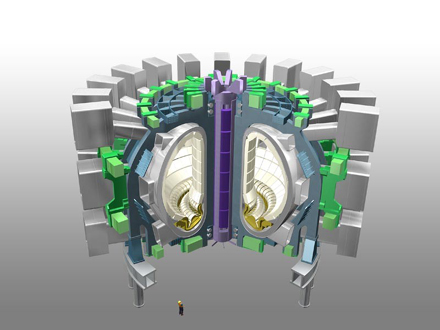
The Tokamak fusion reactor design, based around trapping plasma in a magnetic coil.

Credit: ITER

Within this magnetic field, two isotopes of hydrogen, tritium (atomic mass three) and deuterium (atomic mass two), are heated to around 100 million degrees Celsius. Tritium and deuterium fuse together to form Helium (atomic mass four), and a neutron (atomic mass one). At this temperature, the plasma gas would vaporise any material known, another reason why it is necessary to suspend the gas in a magnetic field.

While expensive, both the tritium and deuterium forms of hydrogen are common commodities. Hydrogen is the most abundant material in the universe, and deuterium can be purified from sea water while tritium is formed from nuclear decay of lithium-6, another common element.

The net result is a form of nuclear power that is much cleaner and safer than conventional nuclear power. It also relies on a much more abundant fuel source than the uranium used by fission reactors. Fusion reactors are also much safer than conventional nuclear reactors, because once the magnetic field fails the reactor cools rather than heats, preventing uncontrolled nuclear reactions.

However, due to the neutrons produced by the process, the reactor material eventually becomes radioactive -- producing hazardous nuclear waste.

Fusion power has long been an area of scientific interest; however Cold War politics impeded the necessary collaboration for serious research. The end of the Cold War allowed for much more co-operation between superpowers and both the US and Russia became part of the ITER at its formation in 1985.

Since then research into fusion power has proceeded at a frantic pace, and rising power costs associated with greenhouse gas emissions have made the technology increasingly viable. Several working experimental reactors exist around the world, including the US DIII-D, the Chinese EAST, the Japanese JT 60, the Russian T-15 and finally the largest of all, the JET based in the UK.

Currently, ITER is working on an international joint project to construct the largest yet fusion reactor in the world, the ITER reactor. The reactor is expected to begin operating in 2016.

News.com's Michael Kanellos contributed to this story.

Advertisement

Talkback 7 comments

    Let's do itLord Watchdog -- 09/02/08

    With wall-to-wall Labor governments in Australia we are unlikely to see companies here get involved with development of fusion technolocy and even less likely to see an operational reactor our power stations, currently powered by coal.

    It is time to stop burning coal and time to start relying on nuclear energy, particularly in Victoria where brown coal has 1/3 the efficiency of the black coal used elsewhere.

    The tokomak!Shaun Steenkamp -- 10/02/08

    The tokomak is overrated in my opinion, it's really not a good way to go. In the words of Dr. Bussard RW (http://video.google.com/videoplay?docid=1996321846673788606) "Nuclear fusion powers the stars, and they don't look toroidal!"

    Inertial electrostatic confinement is a much better approach, and doesn't need to be as large as the ITER facility. Even the United States Department of Defense and the United States Navy have been providing funding for Dr. Bussards' approach. (http://en.wikipedia.org/wiki/Polywell#History)

    Throw the tokomak design away, it's a waste of money!

    50 million dollar fusion reactors in 5 years? I dont think so.Stephen Monteith -- 11/02/08

    The claim that companies could be seriously considering building an efficient 100MW fusion reactor in just 5 years is utterly ridiculous. Heres some quotes from the ITER's wikipedia entry:

    "The program is anticipated to last for 30 years — 10 for construction, and 20 of operation — and cost approximately €10 billion (US$14.6 billion), which would make it one of the most expensive modern technoscientific megaprojects. It is technically ready to start construction and the first plasma operation is expected in 2016"

    and

    "ITER will be designed to produce approximately 500 MW (500,000,000 watts) of fusion power sustained for up to 400 seconds (compared to JET's peak of 16 MW for less than a second) by the fusion of about 0.5 g of deuterium/tritium mixture in its approximately 840 m3 reactor chamber"

    Magnetized Target FusionAnonymous -- 12/02/08

    Michael,
    MTF and ITER are quite different.

    Both MTF and ITER are based on the nuclear fusion of light hydrogen atoms. But MTF is a pulsed system with liquid walls, which compress the fuel to much higher densities, and it has a very short burn time. ITER is a continuous system, with magnets and solid walls.

    ClarifiactionAlex Serpo - ZDNet Australia -- 12/02/08

    Hi Stephen,

    In regard to your comment about fusion, you're right. The ITER project does not propose fusion with the cost suggested in this article.

    Actually, if you read the ITER project, website they aim to see economic fusion reactors by 2045.

    The investors mentioned in this article are likely pinning their hopes on a different type of fusion, possibly the type suggested by Dr. Bussard (thanks for that link Shaun).

    I use the example of the ITER project in this article only because it is an example of a large scale, currently functioning fusion reactor. It demonstrates the technology is a scientific reality, which is half the battle when writing about fusion.

    Thanks for reading

    Alex Serpo

    Australian fusion research does existSteven Sesselmann -- 13/02/08

    I agree with the above comments, that 100 megawatt fusion reactors in five years is a joke, it's not going to happen.

    The good news is that research into fusion energy is silently happening around Australia. Several Australian universities as well as private companies and individuals are making contributions to fusion. Here are some links..

    http://starscientific.com.au/
    http://www.beeresearch.com.au/
    http://www.physics.usyd.edu.au/app/research/plasma/index.html

    All fusion requires confinement of particles, and there are only a few ways we know of to confine these particles .

    * Magnetic confinement
    * Inertial Confinement
    * Electrostatic confinement
    * Gravitational confinement

    All of the above confinement methods can produce fusion, but so far gravitational confinement is the only one that has been of any practical use, in the sun of course.

    The world is awaiting that the dream comes trueWiddi Usada -- 25/04/08

    From the Lawson Criteria, there are only 3 parameters facing for fusion, that are temperature, density and confinement time. But as time goes by, a lot of problems arises such that almost all of famous plasma physicists fail to predict when fusion reactor will come true. Now, the world is expecting so much, that ITER will operate successfully.

Add your opinion


Latest Videos

Blogs

  • David Braue Will Rudd's bush backhaul bonanza deliver?
    Rural areas will be welcoming the government's decision to put its money where its politicising is, funnelling $250m into a regional fibre upgrade to six rural centres. Remedying over a decade of near-neglect at the hands of telecoms privatisation, the investment could be the firmest step yet for Labor's NBN dream — but with inevitable political questions and a looming election, Rudd and Conroy need to deliver, and quickly, to preserve the NBN's credibility.
  • Array Doing for AV what VoIP did for telephony
    Sydney-based start-up Audinate is making traditional analog cabling obsolete in favour of TCP/IP-based networking technology. And it's doing a pretty good job so far, with its technology used by World Youth Day and the Sydney Opera House.
  • Array WiMax in Australia: Part two
    WiMax could be the standard that drives the next phase of mobile broadband, it provides an opportunity for players wanting to establish a pure IP network to carry voice and data effectively — but is this what operators want?
  • More blogs »

Tags

Back to top

Featured