HP: Cutting Edge printers not for sale

Hewlett-Packard's new line of printers may be cutting edge but you won't be able to buy one.
For the first time in history, the company will make customers purchase printing services, rather than the product itself.
The new high-volume ink-based printers are based on a new technology dubbed Edgeline. The products are considered to be HP's biggest printer launch since the company introduced its LaserJet line in 1984, said Gary Cutler, vice president and general manager for Edgeline technologies with its imaging and printing group.
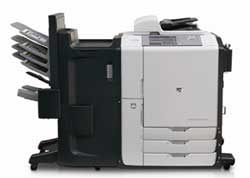
Based on internal research, HP expects the market for products based on Edgeline technology to exceed US$30 billion by 2009.
Edgeline uses a page-wide stationary print-head, decreasing wear and tear by removing contact with the paper. A hydrophilic bonding agent is "fused" to the paper before the ink is applied, resulting in near-immediate touch-dry printing.
"We array these print heads in ways that we move paper underneath and the print head stays stationary ... [which] gives us speed, accuracy, and quality in a very, very simple package," Cutler told reporters at the product launch in Beijing.
Cutler said Edgeline was the largest product development HP's imaging and printing group has undertaken to date.
"The Edgeline offerings will provide customers a multifunction printing solution with ease of use that can improve productivity and lower colour operating costs by up to 30 percent," he claimed.
One drawback for end-users is Edgeline printers cannot be purchased outright and will only be available under a HP managed print contract.
The company couldn't provide pricing details but said the [pricing] structure is per page, depending on output quality.
Cutler suggested an average customer for the HP CM8060 Color MFP might print 20,000 pages per month over a four-year contract with 60 percent mono and 40 percent colour printing.
When asked if HP plans to develop the technology for use in the small business and consumer markets, Cutler said that Edgeline "wants to go up", and envisages possible future use in small-run commercial printing.
Luke Anderson travelled to Beijing as a guest of HP.