Breakthrough promises 40-hour laptop batteries

By Alex Serpo
15 January 2008 04:56 PM
Tags: li-ion, batteries, nanowires, silicon, capacity, battery, charge, lithium

Stanford researchers have made a discovery that could signal the arrival of laptop batteries that last more than a day on a single charge.

The researchers have found a way to use silicon nanowires to give rechargeable Lithium-ion (Li-Ion) batteries used in laptops, iPods, video cameras and mobile phones as much as 10 times more charge, potentially giving a conventional Li-Ion battery-powered laptop 40 hours of battery life rather than four.

The new Li-ion batteries were developed by assistant professor Yi Cui and colleges at Stanford University's Materials Science and Engineering Department. "It's not a small improvement," Cui said. "It's a revolutionary development."

Citing their paper published in Nature Nanotechnology, Cui said the increased Li-Ion battery capacity was made possible though a new type of anode that utilises silicon nanowires. Traditional Li-Ion batteries use graphite as the anode, which limits the amount of lithium -- which holds the charge -- that can be held in the anode, and therefore limits battery life.

Silicon anodes have the "the highest theoretical charge capacity" according to Ciu's paper, but expand when charging and shrink during use: a cycle which causes the silicon to pulverize and so degrading the performance of the battery. This dead end stumped researchers for 30 years, who instead poured their energy into improving graphite based anodes in an effort to expand battery life.

Cui and his colleagues took up this old problem and overcame it, by constructing a new type of silicon nanowire anode. In Cui's anode, the lithium is stored in a forest of tiny silicon nanowires, each with a diameter one-thousandth the thickness of a sheet of paper. The nanowires inflate to four times their normal size as they soak up lithium but, unlike previous silicon anodes, they do not fracture.
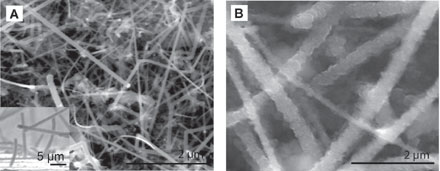
Scanning Electron Microscope images of pristine silicon nanowires before (A) and after (B) electrochemical cycling (charging).

Credit: Nature Nanotechnology

Cui said there a few barriers to commercialising the technology: "We are working on scaling up, and evaluating the cost of our technology. There are no roadblocks for either of these."

Cui has filed a patent on the technology, and is considering formation of a company or an agreement with a battery manufacturer and expects the battery to be commercialised and available within "several years", pending testing.

Advertisement

Talkback 11 comments

    Amazing new invention Anonymous -- 15/01/08

    Let's hope that after this breakthrough, Stanford move on to the perennial problem of getting people to use lower case...

    While your on about it Anonymous -- 15/01/08 (in reply to #320093593)

    And the problem of people ending sentences with more than one full stop.

    Endless problems Anonymous -- 16/01/08 (in reply to #320093602)

    And the problem of people using the word "your" where clearly they should be using "you're". Not to mention starting a sentence with "And".

    Tsk tsk.

    It's not "three full stops". It's an ellipsis. Anonymous -- 16/01/08 (in reply to #320093602)

    Ellipsis (plural ellipses; from Greek ἔλλειψις 'omission') in printing and writing refers to the row of three full stops (… or . . . ) or asterisks (***) indicating an intentional omission. This punctuation mark is also called a suspension point, points of ellipsis, periods of ellipsis, or colloquially, dot-dot-dot. An ellipsis is sometimes used to indicate a pause in speech, an unfinished thought or, at the end of a sentence, a trailing off into silence (aposiopesis).

    Half Baked Journalism Anonymous -- 16/01/08

    A classic case of half baked journalism.

    Reading this article we are led to expect a 10 x improvement in capacity and available within "several years".

    An interview with the inventor here http://www.gm-volt.com/2007/12/21/gm-voltcom-interview-with-dr-cui-inventor-of-silicon-nanowire-lithium-ion-battery-breakthrough
    shows the battery output is limited by both anode and cathode, they've improved the anode only, part of the interview following:

    "If you just changed the anode to nanowire and not the cathode, would the cathode limit the energy potential storage?

    - If you improve the anode that just means for the same weight or same volume of the batteries you can use less anode materials, you can use the extra weight and volume to hold more cathode materials and you also improve the battery significantly.

    - If I take a current batterys cathode materials and combine i with silicon nanowire anode, I can significantly improve its performance.

    Will that give you a ten-fold improvement?

    - That will not give you ten-fold but it will give you several fold improvement."

    "several fold" does not = 10 fold. A simple Google search would have saved the author of misleading thousands.

    Re: Half Baked Journalism Anonymous -- 16/01/08 (in reply to #320093649)

    Hi Anonymous

    In response to your comments, the comment about a ten fold increase comes from the original Stanford University press release. You can find it here:
    http://news-service.stanford.edu/pr/2007/pr-nanowire-010908.html

    I also interviewed Yi Cui, one of the researchers, and read the Nature Nanotechnology paper. These sources also pointed to a 10x increase. Send your email to edit@zdnet.com.au and ill send you the Nature Nanotechnology paper so you can have look. It's an interesting paper.

    Thanks for reading and commenting.

    Alex Serpo

    Cathodes a limitation Anonymous -- 16/01/08 (in reply to #320093668)

    Alex,

    The is no argument they've increased the anode capacity x 10, but it is the capacity of the battery to deliver the charge that counts - it needs the improvement at both anode and cathode - here's another part interview with the inventor where he clearly explains the cathode as a limitation: (from http://www.technologyreview.com/Nanotech/20000/ )

    "Another limitation is that while Cui's silicon nanowires make great anodes, lithium-battery technology has greater need for improved cathodes. In a given battery, substituting an anode that stores more lithium ions has no impact without a corresponding cathode that can supply more charge.

    Both Cui and Wu (who reported his own lithium anode development last month with a high-capacity cobalt-oxide nanowire) say that their labs are working on novel materials for cathodes. "That's the holy grail for this business," says Wu. "Anyone who can generate much higher cathode capacity will bring a huge breakthrough for the lithium battery."

    Looking at your source article from Stanford Uni reference they do indeed make the error of relating the 10 x increase with the overall battery - with the bold heading "Stanford's nanowire battery holds 10 times the charge of existing ones" - so my criticism for poor journalism goes to them, especially coming from a university ! - so please accept my apologies for the harsh comments. I was annoyed an article from great tech source like zdnet turned out misleading from a quick Google search follow-up, you can be likewise from the Stanford Uni source.

    Breakthrough-promises-40-hour-laptop-batteries Dana Lawton -- 20/01/08 (in reply to #320093674)

    Even if we get just a 5 fold increase it would still be extremely siginificant. If we could increase the distance an electric car could travel on one charge by 5X without increasing the weight of the battery, then electric/plug-in cars become much more of a realistic option to the internal combustion engine. This is very big news even if than can only achieve half of what they're saying. I certainly hope these very intelligent gentlmen over at Stanford do not dicker over money. We need to get this technology to the market.

    Way to go Staford Anonymous -- 19/01/08

    I wish i could get the battery soon for my macbook.

    wait a sec... is this a grammar school or are we supposed to talk about batteries?

    Breakthrough and ten-fold" Anonymous -- 03/02/08

    I am suspect. Any insight on how the anode performance delta varied by temperature? Any insight on anode characteristics resiliency? Thanks

    i don't think so Jim brack -- 16/10/08

    i don't believe the battery will work as the original one for security and maintence.days ago i bought a big capacity battery for www.all-battery.co.uk, it can't work continouly.

Add your opinion

Latest Videos

Blogs

  • Darren Greenwood Telecom NZ savings damage prospects
    If Telecom NZ wants to have any of the NZ$1.5 billion the government intends to spend on its new broadband network, it had better think long and hard before offshoring 1500 jobs.
  • Array iiNet: The whys and what nows
    Last week the Federal Court ruled that internet service providers are not responsible for copyright violation by their customers. This is an important decision not just for iiNet, which spent around $4 million defending the case, but for all ISPs in Australia and, indeed, globally.
  • Array Govt, hurry up with releasing data
    A programmer scraped data from the My School website to make some really cool heat maps showing regions of smart schools — no thanks to the government, which didn't supply the data in any useful kind of format.
  • More blogs »

Tags

Back to top

Featured