Is Apple's MacBook Pro rotten to the core?

When companies launch a brand new product it usually takes some time to weed out the niggling issues; but how many systems need to break before the situation is recognised as a disaster rather than an unfortunate blip in quality control?
Less than a year after announcing its new Intel-based MacBook Pro, Apple has taken the market by storm.
Four of the CNET Australia editorial team have bought a new MacBook Pro since its release and every one of them has had to -- or will shortly -- spend some time in the Sydney AppleCentre.
Here are some details:
MacBook Pro delivered to Jeremy, senior editor and producer of CNET.com.au at the end of February 2006.
Worked fine for a couple of months, then the battery started playing up. Even though the MacBook showed there was about 30 percent -- or about 45 minutes -- of life remaining, the system would shut down. This problem has been experienced by all four MacBook Pro owners.
Around a month after the initial problems emerged, the MacBook's battery physically swelled up and the system began shutting down randomly. CNET.com.au did a photo story about this and demanded a recall.
Along with the battery issues, the processor started emitting a whine, which Jeremy described as an "annoying ring tone that buzzes so only teenagers can hear it". At the time Apple said it was normal but just days after the MacBook returned from the repair shop, Apple decided it would also be a good idea to change the motherboard.- MacBook Pro ordered by Zennith, associate editor at CNET.com.au in February and delivered mid-March.
Worked fine till last week when the battery indicator showed the system would take 746 (approximately) hours to charge the battery. Over the next two days the battery died completely and can no longer hold any charge.
Since delivery, the MacBook's case has slowly warped over the superdrive bay and now the lid does not close properly.
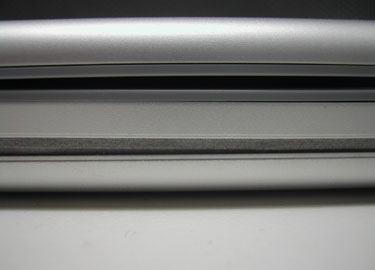
- MacBook Pro ordered by Brendon, editor of Builder AU (builderau.com.au) during April and delivered later that month.
The system has started exhibiting the same early battery symptoms as described in Jeremy's MacBook. With the system shutting down when batter indicator still thinks it has about 45 minutes life remaining.
Another issue in this MacBook Pro relates to its AirPort system. When the AirPort is shut down from OS X, it remains connected to the wireless network. - MacBook Pro ordered and delivered to Ella, associate editor at CNET.com.au, in May.
Was fine till this month when it started exhibiting the same incorrect battery indicator symptoms as Jeremy and Brendon's systems. The MacBook is due to go back to the Apple Service Centre in the near future.
So there we have it. Four MacBook Pro systems and all four requiring at least some attention from Apple.
But how have their MacBook experiences affected their views on Apple as a whole?
Jeremy, who bought the first of the four MacBooks and has had the most problems, remains a fan but is unlikely to be an early adopter next time: "I still love it ... but I'd think twice before getting a first revision product though".
Zennith said she remains faithful to the Mac, but only because her applications of choice are not available on Linux: "When there are open source alternatives on par with Photoshop and iTunes I will use a laptop running Linux".
Brendon, who is a longtime Powerbook user, said: "Luckily this is my work computer so I'm not totally cheesed off. But to buy my own new Mac? Yes I'd wait a while until Apple can sort out some of their bugs. It's definitely got some work to do to before being as stable as my G4."
Ella is the one most affected by her purchase. When asked if her MacBook experience has changed her attitude to Apple products she said: "It has definitely caused me to think harder about the choice -- rather than go Mac by default."
Are the CNET Australia editorial team's experiences of the MacBook representative or have we just been extremely unlucky?
The recent battery recall demonstrates that there are some issues but that is mainly for older notebooks such as the G4 Powerbook and G4 iBook.
So what is wrong with the Intel-based MacBook? At this stage it is difficult to say.
When any company suddenly ramps up its production from virtually nothing to a few million units, there are bound to be some quality issues. We don't think it is a coincidence that the first MacBook to be bought was the one with the most serious issues. This alone could be an indication that Apple is winning the battle.
There are many reasons people buy an Apple system. Some choose Macs for their security while others simply prefer OS X. Some people buy them for their looks and I am sure their market share has been boosted by BootCamp, which allows Mac users to have a dual-boot OS X and Windows system -- but you already know my views on that.
The MacBook Pro was launched about six months after I bought my G4 Powerbook and at the time I remember jealously eyeing the shiny new systems, wishing I had waited.
Now of course, I am very pleased I didn't.